

How to Collect Data
Updated:
January 13, 2026
·
[Read Time]
Historically, organizations have used several approaches to collect and calculate greenhouse gas (GHG) data. Many relied on consultants to manage this complex process. While this can reduce internal workload and provide subject-matter expertise, it often comes with higher costs and ongoing dependence on external partners.
Other organizations collect data internally and calculate emissions manually using spreadsheets, surveys, and email exchanges. Although feasible—particularly in early stages—this approach is time-consuming, difficult to scale, and prone to inconsistency without established systems, processes, and controls.
Today, most organizations use a combination of internal collaboration, supplier engagement, and technology to collect Scope 3 data in a more structured and scalable way.
Effective Scope 3 data collection typically begins internally. Organizations often work closely with teams that interact directly with suppliers and operational data, such as:
These teams help identify relevant suppliers, locate existing activity data, and coordinate data requests. For larger organizations, supplier engagement is often formalized into structured programs with defined timelines, processes, and governance to ensure consistency and accountability.
Organizations typically use one or more of the following approaches, depending on data availability and maturity:
With the emergence of Climate Management and Accounting Platforms (CMAPs), organizations can integrate data from multiple sources into a centralized system to manage, calculate, and report their carbon footprint more efficiently.
Tools such as Persefoni’s Scope 3 Data Exchange (S3DX) Corporate enable organizations to securely request and receive more granular data from suppliers, improving Scope 3 calculations and visibility into supplier climate commitments. By incorporating supplier-specific data where available, these tools help reduce reliance on high-level estimates while supporting consistent reporting and audit readiness.
In addition, some platforms offer no-cost tools for suppliers to calculate and share their Scope 1 and 2 emissions. This lowers barriers to participation—particularly for smaller suppliers—and supports upstream data collection without requiring suppliers to invest in their own software upfront.
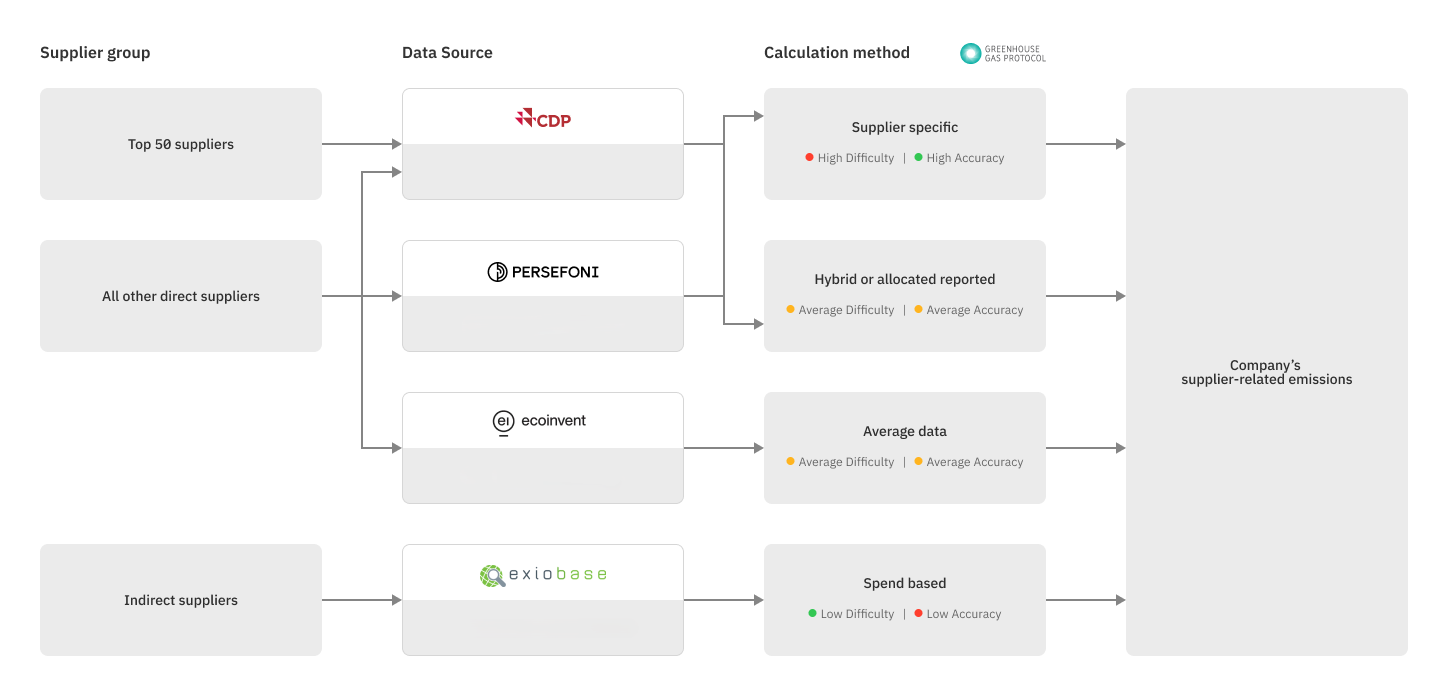
Once data is collected, organizations can calculate their GHG inventory internally or with the support of a CMAP. The next step is to analyze the inventory to identify emissions hotspots, assess data quality, and prioritize reduction opportunities.
Because Scope 3 data collection involves multiple supplier tiers, communication channels, and data formats, it is inherently complex. Partners may be at different stages of climate maturity and may not initially understand why data is being requested. Establishing standardized, targeted data requests and clearly communicating expectations helps streamline collection and improve consistency over time.
Agora works with hundreds of suppliers to manufacture its computers. Early attempts to collect emissions data through ad hoc emails and spreadsheets proved difficult to manage. To improve consistency, Agora develops a standardized survey for its Tier 1 suppliers, requesting emissions data along with information on methodologies and assumptions.
By using a consistent and focused approach, Agora simplifies the data submission process for suppliers, improves data quality, and reduces the burden on both suppliers and internal teams. Over time, this standardized approach enables Agora to scale Scope 3 data collection and progressively improve the accuracy of its emissions inventory.
Effective Scope 3 data collection is a balance between feasibility and precision. By combining internal collaboration, structured supplier engagement, and the right technology, organizations can collect data in a way that is scalable, consistent, and supportive of long-term climate goals.

