

Scope 3 within Corporations
Updated:
January 13, 2026
·
[Read Time]
Global organizations must understand and analyze the role of scope 3 emissions as they work to address climate change and advance sustainability efforts. For many companies, scope 3 emissions represent the largest share of their greenhouse gas (GHG) footprint, making value-chain emissions a critical focus area for credible climate action and long-term business resilience.
The Science Based Targets initiative (SBTi) is a collaborative partnership that defines and promotes best practices for setting science-based emissions reduction targets. As discussed in Module 4, Lesson 2, SBTi provides guidance, tools, and validation services to support organizations throughout their decarbonization journeys.
Science-based targets (SBTs) are emissions reduction targets aligned with the goals of the Paris Agreement, which aims to limit global temperature increase to well below 2°C above pre-industrial levels while pursuing efforts to limit warming to 1.5°C. SBTs provide organizations with a clear, science-aligned pathway to reduce GHG emissions while responding to evolving investor, customer, and regulatory expectations.
As pressure from stakeholders continues to increase, SBTs are becoming an essential component of credible corporate climate strategies, signaling that emissions reduction commitments are grounded in climate science rather than incremental improvement.
Science-based targets hold companies accountable for reducing greenhouse gas emissions across their operations and value chains. Because scope 3 emissions often constitute a substantial proportion of an organization’s total carbon footprint, they play a critical role in many SBTs.
SBTi applies a materiality-based approach to scope 3 emissions. When scope 3 emissions account for 40% or more of a company’s total emissions, organizations are required to set scope 3 emissions reduction targets. These targets must focus on the most significant value-chain emissions sources and cover a substantial share of overall scope 3 emissions.
Including scope 3 emissions within climate strategies enhances an organization’s credibility by supporting:
In 2015, all United Nations Member States adopted the 2030 Agenda for Sustainable Development, introducing 17 Sustainable Development Goals (SDGs). These global goals address interconnected economic, social, and environmental challenges and provide a shared framework for advancing sustainable development worldwide.
The 17 SDGs are:
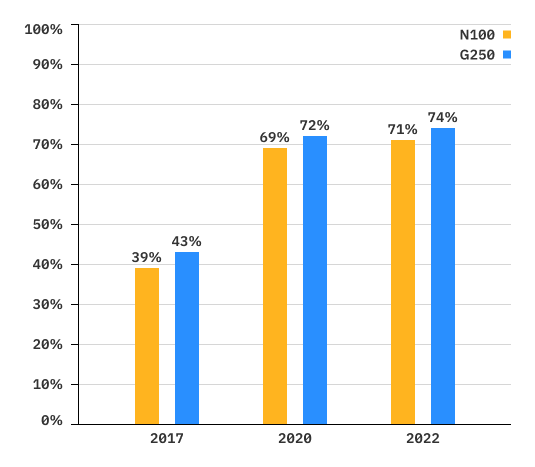
Reducing scope 3 emissions enables companies to address indirect emissions throughout their value chains while contributing to global progress toward the UN SDGs. According to a KPMG survey, nearly three-quarters of the world’s 250 largest companies by revenue reported on the SDGs between 2017 and 2022, reflecting the growing importance of aligning corporate action with global sustainability goals.
Global SDG Reporting Rates (2017 - 2022)
Scope 3 emissions reduction efforts are particularly aligned with:
While the UN SDGs provide a high-level global framework for addressing societal and environmental challenges, reporting and accounting frameworks—such as those discussed in the previous lesson—offer organizations more specific guidance for measuring, managing, and communicating progress.
Stephanie, Agora’s sustainability manager, understands the connection between scope 3 emissions mitigation and broader support of the UN SDGs. In the company’s inaugural corporate impact report, she includes a comprehensive inventory of emissions across scopes 1, 2, and 3, along with an overview of how Agora’s sustainability strategy supports SDGs 12, 13, and 17.
Stephanie also recognizes the importance of science-based targets and includes Agora’s validated SBT in the report. The company commits to ambitious, science-aligned emissions reductions across scopes 1, 2, and 3 by 2030, with a particular focus on material scope 3 categories such as purchased goods and services, transportation, and distribution.

