Im Jahr 2025 war Mexiko das erste Land in Nordamerika, das ISSB-konforme Standards zur Offenlegung von Nachhaltigkeitsinformationen vollständig verpflichtend eingeführt hat. Die Anforderungen der IFRS S1 und S2 sind nun Teil der allgemeinen Wertpapiervorschriften des Landes, bekannt als CUE, und gelten für Emittenten von Eigenkapital, Schuldtiteln und anderen Wertpapieren, die von Mexikos Nationaler Banken- und Wertpapierkommission (CNBV) beaufsichtigt werden, wobei die Berichterstattung ab 2026 auf Basis der Daten von 2025 beginnt.
Mit der Einführung obligatorischer Standards, die sich an das International Sustainability Standards Board (ISSB) anlehnen, hat sich Mexiko entschieden an die Spitze der Klimaberichterstattung in Nordamerika gesetzt. Es schließt sich einer wachsenden Gruppe von Jurisdiktionen weltweit an, die sich um den gemeinsamen Berichtsrahmen und die Sprache des ISSB versammeln, mit dem Ziel, die Transparenz über die finanziellen Risiken zu erhöhen, denen Unternehmen infolge des Klimawandels und von Nachhaltigkeitsthemen ausgesetzt sind.
In diesem Artikel werden wir uns eingehend mit Mexikos ISSB-Standards befassen: Was sie vorschreiben, warum sie eingeführt wurden und wie sich Unternehmen auf die Berichterstattung vorbereiten können.
Hintergrund: Was sind die ISSB-Standards?
Zwei Standards, IFRS S1 und IFRS S2, wurden entwickelt, um eine globale Basis für die Klimaberichterstattung zu schaffen.
Im Jahr 2021 hat das International Sustainability Standards Board (ISSB) zwei Standards herausgegeben, die darauf abzielen, fragmentierte Leitlinien zur Nachhaltigkeitsberichterstattung zu konvergieren und eine globale Basis für die Berichterstattung zu schaffen: Allgemeine Anforderungen an die Offenlegung nachhaltigkeitsbezogener Finanzinformationen (IFRS S1) und Klimabezogene Angaben (IFRS S2). Bislang haben mehr als 30 Jurisdiktionen weltweit die ISSB-Standards teilweise oder vollständig in ihre Vorschriften integriert.
Das ISSB baute die Standards auf dem Fundament auf, das von der Task Force on Climate-Related Financial Disclosures (TCFD)geschaffen wurde, die die Praktiken und Vorschriften zur Klimaberichterstattung in den letzten zehn Jahren geprägt hat. IFRS S1 und S2 stützen sich auf andere bekannte Rahmenwerke, einschließlich derer des Climate Disclosure Standards Board (CDSB) und des Sustainability Accounting Standards Board (SASB). Sie bieten Unternehmen auch die Möglichkeit, Offenlegungen auf der Grundlage der European Sustainability Reporting Standards (ESRSs) und der Global Reporting Initiative (GRI), solange diese Offenlegungen darauf ausgelegt sind, den Bedürfnissen der Investoren gerecht zu werden.
Das ISSB ist ein unabhängiger Standardsetzer – es legt keinerlei Anforderungen für Gerichtsbarkeiten oder Unternehmen fest. Seine Standards sind darauf ausgelegt, den Märkten zu dienen und eine Struktur für konsistente und vergleichbare Vorschriften über Grenzen hinweg zu schaffen. Eine wachsende Zahl von Gerichtsbarkeiten, darunter Mexiko, integriert jedoch IFRS S1 und S2 in ihre verbindlichen Finanzberichterstattungsvorschriften.
.png)
Warum hat Mexiko die ISSB-Standards übernommen?
Die Angleichung schafft eine Grundlage, um Unternehmen dabei zu helfen, globale Erwartungen zu erfüllen.
Mexikos Umsetzung der ISSB-Anforderungen ist Teil eines globalen Trends. Angesichts der steigenden Investorennachfrage nach konsistenten, entscheidungsrelevanten Nachhaltigkeitsinformationen übernehmen Länder weltweit freiwillige und verbindliche, an die ISSB angepasste Berichtsstandards. Hinter Mexikos Übernahme von IFRS S1 und IFRS S2 stehen mehrere treibende Kräfte:
- Erhöhte Transparenz und globaler Kapitalzugang. Investoren erwarten zunehmend zuverlässige, transparente und vergleichbare Nachhaltigkeitsinformationen. IFRS S1 und S2 bieten eine globale Grundlage für die Vergleichbarkeit, und die Übernahme der Standards hilft mexikanischen Unternehmen, um globale Investitionen zu konkurrieren.
- Reifere Erwartungen an die Nachhaltigkeitsberichterstattung. Mexikos Übernahme der ISSB-Standards spiegelt eine weltweite Entwicklung wider, weg von narrativer, verallgemeinerter ESG-Berichterstattung hin zu strukturierten, datengestützten Offenlegungen von Nachhaltigkeitsrisiken, die mit Finanzberichten verknüpft sind.
- Nationale Übergangsstrategie. Mexiko hat sich verpflichtet, bis 2050 Netto-Null-Emissionen zu erreichen, mit tiefgreifenden Emissionsreduktionen bis 2035. Die Identifizierung, das Management und die Offenlegung von unternehmerischen Klimarisiken und -chancen spielen eine entscheidende Rolle bei der Erreichung der Dekarbonisierungsziele.
- Ziel ist eine minimale Abweichung von der globalen Basislinie. Durch die vollständige Übernahme von IFRS S1 und S2 reduziert Mexiko die Komplexität für Unternehmen, die international tätig sind oder in mehreren Gerichtsbarkeiten berichten. Die Einhaltung der globalen Basislinie verhindert auch, dass Mexiko zu einem Ausreißer mit einzigartigen Offenlegungsvorschriften wird, die Investoren lernen müssen.
Was verlangen Mexikos Nachhaltigkeitsstandards?
Unternehmen müssen jährliche Nachhaltigkeitsberichte einreichen.
Im Januar 2025 veröffentlichte Mexikos Nationale Banken- und Wertpapierkommission (CNBV) Änderungen ihrer allgemeinen Wertpapierbestimmungen (bekannt als Circular Unica de Emisoras oder CUE), in denen festgelegt wird, dass Wertpapieremittenten nachhaltigkeitsbezogene Finanzinformationen offenlegen müssen gemäß den ISSB-Standards.
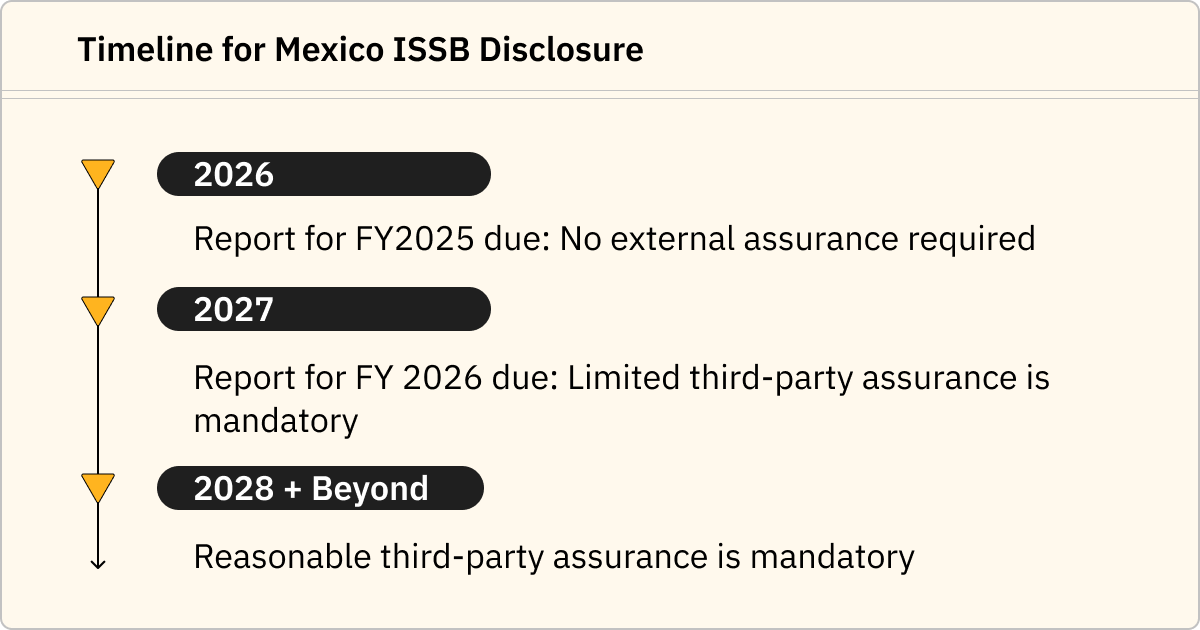
Unternehmen, die den CUE-Bestimmungen unterliegen, müssen ab 2026 zusätzlich zu ihren Finanzberichten separate, ISSB-konforme jährliche Nachhaltigkeitsberichte einreichen. Die Prüfungsanforderungen werden schrittweise eingeführt: 2026 ist keine Prüfung erforderlich, 2027 eine eingeschränkte Prüfung und 2028 eine angemessene Prüfung.
Was bedeutet die Anwendung von IFRS S1 und S2?
Mexiko hat IFRS S1 und IFRS S2 vollständig übernommen, was bedeutet, dass Emittenten, die den Vorschriften unterliegen, die folgenden Informationen in ihre jährlichen Nachhaltigkeitsberichte aufnehmen müssen:
IFRS S1 (Allgemeine Anforderungen)
- Governance in Bezug auf nachhaltigkeitsbezogene Risiken und Chancen
- Strategie und wie Nachhaltigkeitsthemen Geschäftsmodell, Strategie und Entscheidungsfindung beeinflussen
- Risikomanagementprozesse zur Identifizierung, Bewertung und Steuerung nachhaltigkeitsbezogener Risiken
- Kennzahlen und Ziele zur Überwachung und Steuerung nachhaltigkeitsbezogener Risiken und Chancen
- Stärkere Betonung der finanziellen Wesentlichkeit und der Verbindung zu Finanzberichten und Unternehmensplanung
IFRS S2 (Klimabezogene Angaben)
- Klimaspezifische Governance, Strategie, Risikomanagement sowie Kennzahlen/Ziele
- Klimabezogene Risiken und Chancen (Übergangs- und physische Risiken)
- Emissionen (Scope 1, 2 und 3)
- Ziele, Übergangspläne und Leistung im Vergleich zu diesen Zielen
- Szenarioanalyse und Klimaresilienz (soweit zutreffend)
Wer unterliegt Mexikos Nachhaltigkeitsstandards?
In- und ausländische Emittenten müssen die Vorschriften einhalten, Finanzinstitute sind jedoch derzeit ausgenommen.
Mexikos Nachhaltigkeitsberichtspflichten gelten für Emittenten von Eigenkapital-, Fremdkapital- und anderen Wertpapieren, die von der Nationalen Banken- und Wertpapierkommission (CNBV) beaufsichtigt werden, was schätzungsweise 86 % der Marktkapitalisierung des wichtigsten mexikanischen Aktienindex ausmacht.
Die Vorschrift gilt auch für ausländische Emittenten, die die Möglichkeit haben, die Standards ihres eigenen Landes einzuhalten, sofern sie Dokumente vorlegen, die die Gleichwertigkeit des Rahmens ihrer Gerichtsbarkeit mit IFRS S1 und S2 belegen.
Obwohl Finanzinstitute noch nicht den ISSB-Bestimmungen unterliegen, sind Banken- und Wertpapieraufsichtsbehörden dabei zu ermitteln, wie gleichwertige Offenlegungspflichten für Finanzinstitute festgelegt werden können.
Unternehmen ohne öffentliche Rechenschaftspflicht unterliegen nicht den CUE-Vorschriften. Mexikos nationaler Standardsetzer, CINIF, hat jedoch zwei separate Standards für Nachhaltigkeitsinformationen für private Unternehmen veröffentlicht. NIS A-1 und NIS B-1, die wesentliche Elemente des ISSB enthalten, gelten für Unternehmen, die nicht von öffentlichem Interesse sind und ihre Finanzberichte gemäß den mexikanischen Rechnungslegungsstandards (NIF) erstellen.
Wie ist der Zeitplan für die Offenlegung?
Berichte sind 2026 fällig, basierend auf Daten von 2025.
Mexikos ISSB-Vorschriften traten am 29. Januar 2025 in Kraft. Sie verpflichten alle Emittenten (außer Finanzinstitute, Staaten und Gemeinden), ab 2026 nachhaltigkeitsbezogene Finanzinformationen zu erstellen, basierend auf Daten des Geschäftsjahres 2025. Die Prüfungsanforderungen werden schrittweise eingeführt, wobei im ersten Jahr keine Prüfung erforderlich ist. Im zweiten Jahr müssen Unternehmen eine eingeschränkte Prüfung (limited assurance) einholen, gefolgt von einer angemessenen Prüfung (reasonable assurance) im dritten Jahr und darüber hinaus.
Wie können sich Unternehmen auf die ISSB-Berichterstattung in Mexiko vorbereiten?
Eine solide Grundlage für das Datenmanagement wird die Offenlegung optimieren.
Wenn Sie den ISSB-Anforderungen Mexikos unterliegen, müssen Sie Ihre erste Offenlegung im Jahr 2026 veröffentlichen und 2027 eine eingeschränkte Prüfung (limited assurance) einholen. Sie können die folgenden Schritte befolgen, um den Prozess zu optimieren und Vertrauen in Ihre Berichterstattung aufzubauen.
1. Eine Lückenanalyse durchführen
Beginnen Sie mit einer strukturierten Lückenanalyse. Identifizieren Sie alle Jahresberichte, CDP-Berichteoder andere Dokumente, in denen Sie bereits nachhaltigkeitsbezogene Risiken und Chancen offengelegt haben, und ordnen Sie diese Informationen dann den Anforderungen von IFRS S1 und S2 zu. Dokumentieren Sie Inkonsistenzen und Bereiche, in denen noch messbare Daten benötigt werden, insbesondere bei der Emissionsberichterstattung.
2. Eine Grundlage für zuverlässiges, robustes Datenmanagement schaffen
Um Mexikos neue hohe Anforderungen an Datenpräzision und Transparenz zu erfüllen, müssen Sie robuste Datenmanagementprozesse entwickeln. Beginnen Sie damit, klare Datenverantwortlichkeiten über alle Teams hinweg festzulegen (z. B. Nachhaltigkeit, Beschaffung, Finanzen, Personalwesen). Wählen Sie Datenmanagement-Software und -Tools aus, um eine präzise und effiziente Berichterstattung zu unterstützen. Überprüfen Sie Ihre Emissionsberechnungsmethoden auf Konsistenz.
3. Klimarisiken in Strategie und Planung integrieren
Identifizieren Sie klimabezogene Risiken und Chancen, die Ihre finanzielle Leistung, Position oder Zukunftsaussichten vernünftigerweise beeinflussen könnten. Richten Sie Ihre Risikobewertungen an bestehenden Unternehmensrisikomanagement- und Finanzplanungsprozessen aus.
4. Governance, Kontrollen und Dokumentation etablieren
Mit der Einführung der ISSB-Standards stehen Nachhaltigkeitsinformationen unter erhöhter Beobachtung, und die Prüfungsanforderungen treten nächstes Jahr in Kraft. Es ist wichtig, mit der Formalisierung interner Kontrollen zu beginnen. Definieren Sie zunächst klar die Rollen und Verantwortlichkeiten für die Datenerfassung, -prüfung und -genehmigung. Dokumentieren Sie die für Emissionsberechnungen verwendeten Methoden und bereiten Sie sich auf Audits vor (in Mexiko ist ab 2027 eine eingeschränkte Prüfung erforderlich, die sich ab 2028 zu einer angemessenen Prüfung entwickelt).
5. Einen Plan zur Verbesserung der Datenqualität entwickeln
Erstellen Sie eine mehrjährige Roadmap, die schrittweise die Qualität und den Umfang der Daten aufbaut. Ihre Roadmap sollte zunächst Offenlegungsbereiche mit hoher Relevanz priorisieren (z. B. Emissionen, Governance, wesentliche Klimarisiken) und Sie auf sich schnell entwickelnde regulatorische Vorgaben und Investorenanforderungen vorbereiten.
Vorbereitung auf die ISSB-konforme Klimaberichterstattung in Mexiko
Mit der Einführung der verbindlichen ISSB-Standards hat sich Mexiko an die Spitze der Klimaberichterstattung in Nordamerika gesetzt. Unternehmen, die den mexikanischen Anforderungen unterliegen, beginnen 2026 mit der Berichterstattung, basierend auf Daten aus dem Jahr 2025. Durch die frühzeitige Etablierung zuverlässiger Systeme für die Datenerfassung und -berechnung können Unternehmen in Mexiko den Übergang zur obligatorischen Berichterstattung erleichtern, auf die Erwartungen der Stakeholder reagieren und die Grundlage für die Einhaltung zukünftiger Vorschriften legen.
Erfahren Sie mehr darüber, wie Persefoni Sie bei der Vorbereitung auf die Klimaberichterstattung in Mexiko unterstützen kann.
FAQ
Welche ISSB-Standards übernimmt der mexikanische Rahmen?
IFRS S1 Allgemeine Anforderungen für die Offenlegung nachhaltigkeitsbezogener Finanzinformationen und IFRS S2 Klimabezogene Angaben sowie alle zukünftigen ISSB-Standards.
Welche Informationen müssen Unternehmen offenlegen?
Betroffene Unternehmen müssen über nachhaltigkeitsbezogene Risiken und Chancen berichten, von denen vernünftigerweise erwartet werden kann, dass sie kurz-, mittel- oder langfristig Cashflows, den Zugang zu Finanzierungen oder die Kapitalkosten beeinflussen.
Wie beabsichtigt Mexiko, die offengelegten Informationen zu nutzen?
Die in den Offenlegungen enthaltenen Informationen sind für bestehende und potenzielle Investoren, Kreditgeber und andere Gläubiger bestimmt.
Verlangt Mexiko nachhaltigkeitsbezogene Offenlegungen als Teil der allgemeinen Finanzberichte?
Nach dem Gesetz müssen Organisationen die in IFRS S1 und IFRS S2 dargelegten Informationen als Teil eines separaten jährlichen Nachhaltigkeitsberichts aufnehmen. Unternehmen müssen ihre Nachhaltigkeitsangaben gleichzeitig mit den zugehörigen Finanzberichten veröffentlichen (vorbehaltlich einer Übergangserleichterung für die erste Berichtsperiode).
Gelten die Standards für ausländische Unternehmen?
Alle ausländischen Emittenten müssen gemäß den ISSB-Standards offenlegen oder die geltenden Standards ihrer Heimatgerichtsbarkeit. Wenn sie sich dafür entscheiden, ihre Heimatstandards zu befolgen, muss ihre Offenlegung die Interoperabilität oder Äquivalenz der Standards mit den ISSB-Standards erläutern.
Müssen Finanzinstitute gemäß ISSB offenlegen?
Finanzinstitute unterliegen den Standards noch nicht, aber die mexikanischen Banken- und Wertpapieraufsichtsbehörden prüfen derzeit, wie äquivalente Anforderungen für Finanzinstitute festgelegt werden können.
Unterliegen private Unternehmen den mexikanischen Nachhaltigkeitsstandards?
Nein, die ISSB-Standards im CUE gelten nur für Unternehmen mit öffentlicher Rechenschaftspflicht. Der Consejo Mexicano de Normas de Información Financiera (CINIF) hat jedoch eine Reihe lokaler Standards, bekannt als NIS A-1 und NIS B-1, veröffentlicht, die für Unternehmen ohne öffentliches Interesse gelten, die Finanzberichte gemäß den Financial Information Standards (NIF) erstellen.