

Introduction to Emission Factors
Updated:
January 13, 2026
·
[Read Time]
Module 2 breaks down the basics of how scope 3 emissions are estimated. We will cover the importance of emission factors and the different methods associated with measuring them. By completing this module, you will:
The estimated time to complete is 15 min.
Once an organization has determined which Scope 3 emission categories (upstream or downstream) are material to its footprint, the next step is to quantify those emissions. This is done by converting business activity data into emissions data using emission factors.
The U.S. Environmental Protection Agency (EPA) defines an emission factor (EF) as:
“A representative value that attempts to relate the quantity of a pollutant released to the atmosphere with an activity associated with the release of that pollutant.”
In simple terms, an emission factor answers the question:
How much greenhouse gas is emitted per unit of activity?
Emission factors are applied to business activity data, which represents any measurable activity that results in greenhouse gas emissions.
Common examples include:
Business activity data
Corresponding emission factors
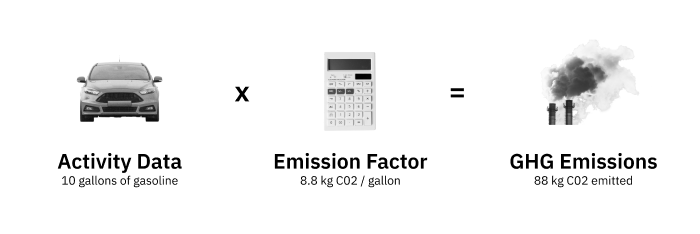
To calculate emissions, organizations simply multiply the activity data by the appropriate emission factor:
Activity data × Emission factor = GHG emissions
This calculation is the basic building block of carbon accounting and applies across Scope 1, Scope 2, and Scope 3 emissions.
Emission factors play a critical role in determining the accuracy and credibility of emissions calculations. The choice of emission factor influences:
Because of this, emission factors that are open-source, transparent, and regularly updated are generally preferred. Emission factor sets published by government agencies, academic institutions, and reputable research organizations are widely used and trusted.
Governments, researchers, and private organizations regularly update emission factors to reflect changes in energy systems, technologies, and scientific understanding. Selecting appropriate and up-to-date emission factors is therefore an essential step in building a reliable greenhouse gas inventory.
Emission factors connect real-world business activities to greenhouse gas emissions. By applying the right emission factors to activity data, organizations can quantify their emissions consistently and transparently, forming the foundation for accurate carbon accounting and informed climate decision-making.

