In the summer of 2026, the Science Based Targets initiative (SBTi) introduced updates to its corporate net-zero standard. Version 2.0 brings changes to multiple areas, including new company categories and requirements for governance, target-setting, implementation, reporting, and ongoing assessment. One of the most significant changes is the shift to recurring progress reporting. In addition to target validation, companies must now develop systems for ongoing tracking of emissions.
On June 11, 2026, the Science Based Targets initiative (SBTi) released the final Corporate Net-Zero Standard Version 2.0, the first full rewrite of the framework that more than 11,000 companies use to set decarbonization targets.
The new version is aimed at connecting climate ambition to real economic decisions that support decarbonization, according to SBTi. In announcing the new standard, SBTi CEO David Kennedy explained: “We are at a critical moment for climate action: companies have told us that they need a partner that can help foster implementation and that’s what the Corporate Net-Zero Standard Version 2.0 is designed to do.”
In this guide, we’ll cover what you need to know about the latest changes to the SBTi corporate net-zero standard and steps you can take to prepare.
Moving from ambition to implementation
The V2.0 framework is aimed at closing the gap between commitments and impact.
SBTi was founded in 2015 by CDP, the UN Global Compact, World Resources Institute, and WWF to give companies a way to set emissions targets grounded in climate science. Since it started, SBTi has grown into the world’s leading corporate target-validation body. The thousands of companies that have committed to SBTi targets represent over 40% of global market capitalization and roughly a quarter of global revenue.
Commitments have spiked in the past few years: Between 2023 and 2025, the number of companies setting science-based targets increased 97%, according to SBTi. But that growth was accompanied by a gap. While businesses reported positive impact from setting decarbonization targets, they weren’t consistently meeting those targets. One independent study found that only 60% hit their goals.
The Corporate Net-Zero Standard V2.0 aims to close that gap. According to SBTi, V2.0 heralds a new phase of transition: from climate ambition to real-world implementation.
“When the SBTi was founded over a decade ago, the aim was simple: help companies set targets to reduce their emissions in line with climate science. In the decade since, companies have recognized that ambition alone is not enough—delivery is paramount.”
Francesco Starace, SBTi Chair of the Board of Trustees
SBTi Corporate Net-Zero Standard 2.0: What’s changed?
SBTi Version 2.0 builds on the original framework. It brings comprehensive updates across multiple areas, including company categorization, governance, target-setting, implementation, reporting, and ongoing emissions removal responsibility. Here’s a look at core elements of the new framework:
Company categorization
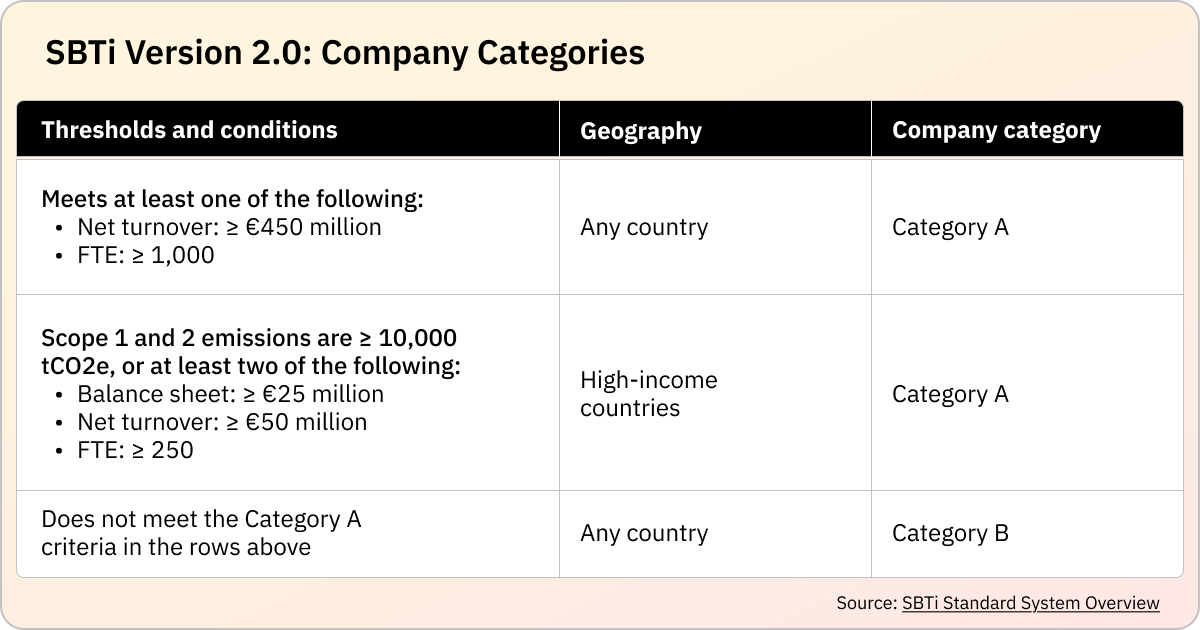
V2.0 moves from a one-size-fits-all approach to differentiated requirements based on company size and geography. Category A includes companies in any country with at least €450 million in net turnover or 1,000 full-time employees. Companies in high-income countries may also qualify based on their Scope 1 and 2 emissions or a combination of balance sheet, turnover, and employee thresholds. Companies that do not meet the Category A criteria are classified as Category B.
Under the new standard, certain mandatory requirements for Category A companies are optional for Category B companies. These requirements include disclosure of transition plans, assurance, and scope 3 target-setting.
Net-zero governance
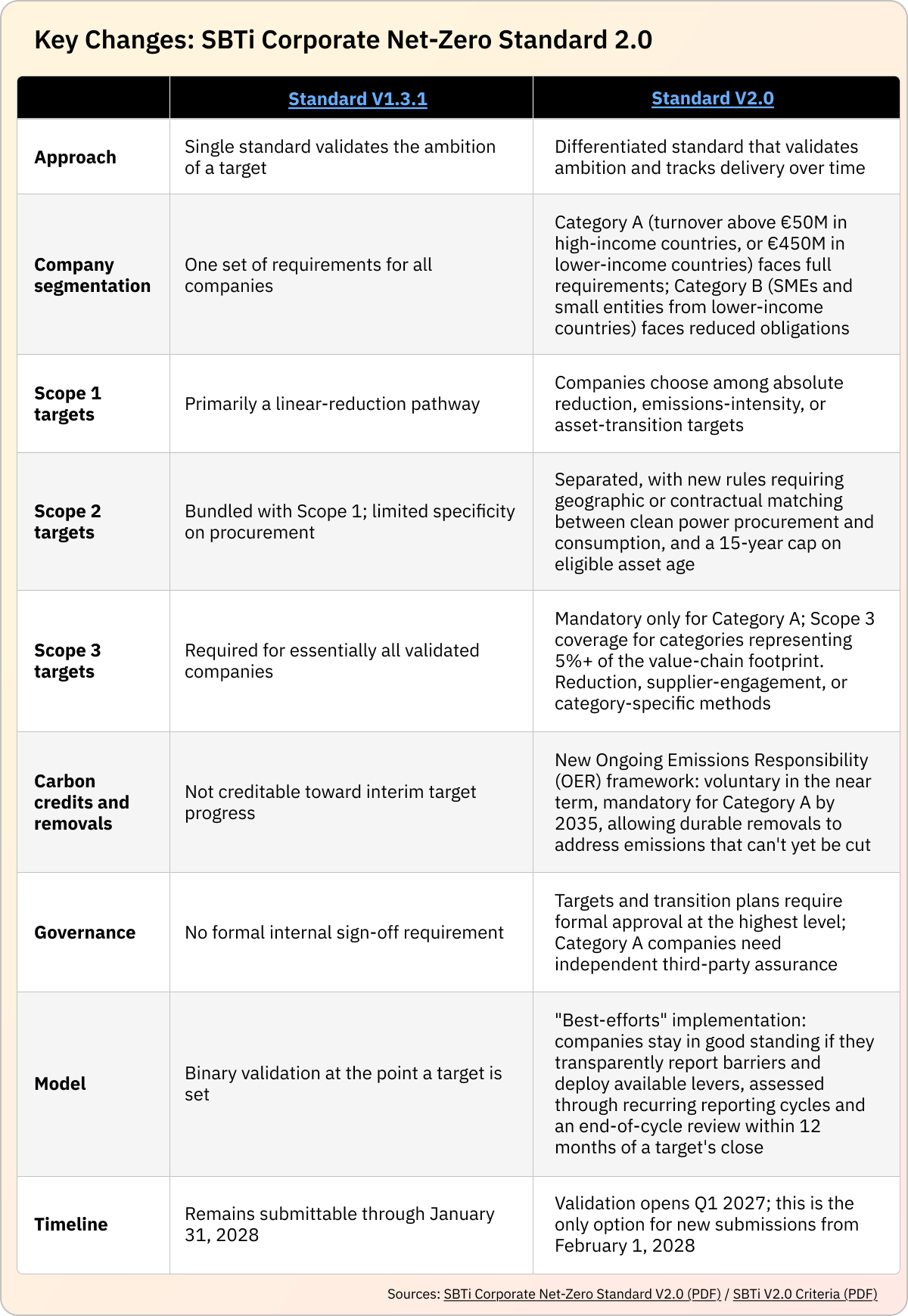
To ensure that climate ambitions are embedded in day-to-day operations and decision-making, SBTi has added expectations for governance. The updated framework calls on businesses to secure formal approval of targets from the highest levels of their organizational leadership and develop and maintain transition plans outlining how they will implement the targets.
Target setting
The new version separates Scope 1 and Scope 2 target-setting. Companies must set near-term Scope 1 targets and can choose from three science-based approaches: absolute emissions reduction, emissions intensity reduction, or asset transition.
Companies must also set separate near-term Scope 2 targets based on reductions in emissions and/or increased use of low-carbon electricity.
Scope 3 stays mandatory for Category A companies and optional for Category B, with near-term targets required to cover significant Scope 3 categories. Limited, justified exclusions are allowed, including categories that individually account for less than 5% of total Scope 3 emissions.
Target implementation and transition plans
Under the updated standard, companies are expected to employ all available levers for reductions and proactively address any barriers. They must develop transition plans detailing the actions, timelines, and assumptions behind reaching targets.
Version 2.0 introduces an implementation hierarchy to support decarbonization of the systems and activities that generate a company’s emissions. When direct action isn’t feasible, companies can take action within shared systems like electricity grids or logistics networks. If that isn’t possible, they can act at the sector level. The standard also recognizes that a broad range of actions can contribute to progress, including projects and market instruments.
Ongoing reporting on target progress
In V2.0, SBTi introduces a cycle of target setting, regular reporting, end-of-target cycle assessment, and target renewal. This is a significant shift, from a focus on validation of targets to recognition of decarbonization progress.
Progressive responsibility for ongoing emissions
While the SBTi’s priority is still decarbonization of operations and value chains, its Ongoing Emissions Responsibility (OER) program recognizes companies for taking voluntary steps to tackle emissions released on the path to net zero. Actions may include reductions, carbon removals, mitigation funding, low-carbon research and development, adaptation and resilience, and loss and damage response.
Removals must be scaled to enable long-term neutralization of residual emissions at the net-zero target year. They are reported separately and don’t count toward a company’s scope 1-3 targets. From 2035, Category A companies will be required to address part of their ongoing emissions with removals. This guidance aims to progressively increase the proportion of removals, so that by the time companies reach their net-zero target, the remaining residual ongoing emissions are neutralized. A list of the requirements for different OER recognition tiers is available here.
SBTi Corporate Net-Zero Standard: Transition Timing
SBTi provides guidance on transitioning from the previous standard
SBTi recognizes that companies are at different stages in their decarbonization journeys, and has provided guidance aimed at supporting a smooth transition to V2.0: Many elements of the updated standard are now available under Version 1, such as company categorization and progress assessment. Version 1 will remain open for target-setting through January 2028. Companies can continue to use Version 1 as an on-ramp to SBTi, and those whose planning is based on Version 1 can submit targets on that basis. Companies that already have 2030 targets should start to set targets for the next cycle under V2.0 from 2028, in order to allow sufficient lead time.
Companies setting or updating targets before 2028
Companies are encouraged not to delay target setting, and are welcome to continue to use V1 for target setting until January 2028. The targets of companies following this approach will remain valid for the full target cycle; companies will then set targets under V2.0 for the subsequent cycle.
Companies with target years 2030 onwards
Companies with existing targets set for 2030 or later, as well as those falling under the mandatory five-year review in 2028, are advised to maintain their current targets. They should plan to transition to V2.0 for the next cycle (2030-35), setting new targets from 2028. In the meantime, and for the remainder of the current cycle, key innovations under V2.0 will apply to V1.
Source: SBTi
How does the new standard affect businesses?
Companies must now show recurring, transparent progress reporting.
Organizations should use the current transition period to decide whether they will submit under the current framework or prepare for V2.0. SBTi has made it clear that companies do not need to redo targets immediately. However, V2.0 will likely prompt new operational needs, and there are a few changes that are worth paying attention to now:
- Company categories change obligations. You should know which side of the Category A/B line you’re on, since that determines whether scope 3 target-setting is mandatory or optional, and whether third-party assurance applies.
- Target validation will be complemented by ongoing reporting and assessment. Under V2.0, companies must show recurring, transparent progress reporting and complete an end-of-cycle assessment. This creates a standing operational need beyond the initial validation process, with implications for internal systems, data pipelines, and reporting cadences.
- Carbon removals are an important piece of the puzzle. SBTi has signaled its intention to introduce a mandatory ongoing emissions responsibility requirement for Category A companies from 2035, subject to review in the next major revision of the Standard. Companies may want to start evaluating removal supply well ahead of that potential requirement.
- Climate target governance is becoming more formalized. Targets must be approved at the highest level of governance, and companies must develop transition plans supported by governance arrangements that oversee implementation. Category A companies are also subject to independent third-party assurance requirements for specified emissions data and progress assessments.
Preparing for SBTi Version 2.0: A Checklist
SBTi Version 2.0 introduces more than new target-setting criteria. It changes how companies are expected to manage, govern, and demonstrate progress toward their climate goals over time. While some implementation details are still forthcoming, companies can begin preparing now by understanding how the new requirements apply to the and identifying where their current processes may need to evolve. The following steps can help sustainability teams get ahead of the transition and build the foundations needed for Version 2.0.
1. Determine your company category now.
Review the full Category A criteria, including turnover, employee count, Scope 1 and 2 emissions, balance sheet size, and geography. Your classification will determine requirements including Scope 3 target-setting and assurance under V2.0.
2. Assess your current climate targets and plans.
Review your carbon inventory and transition plans. Evaluate your energy procurement and power purchase agreements, decarbonization strategies, supply chain issues, and public sustainability claims against V2.0 guidance.
3. Build the internal systems for ongoing reporting.
V2.0 adds recurring progress reporting and end-of-cycle assessment alongside target validation. Companies should treat emissions data collection and progress reporting as a standing process well before their next target renewal.
4. Get governance structures in place early.
Your targets need to be approved at the highest level. Sustainability teams should review approval processes and start sharing V2.0 requirements with boards and executive leadership.
5. Keep an eye out for updates.
Several of the specifics that will determine the day-to-day compliance needs haven't been published yet. SBTi has flagged coming updates, including a Q4 2026 release of interpretation guidance, interim accounting guidance, and more.
6. Start evaluating removals early.
SBTi intends to introduce an ongoing emissions responsibility requirement for Category A companies from 2035, subject to review in the next major revision of the Standard. Companies may want to begin evaluating durable carbon removal options and availability well ahead of that date.
Moving from ambition to impact
The advantages of setting net-zero goals are clear. Companies with validated climate targets report positive impacts on reputation, strategy, supply chain alignment, stock price volatility, long-term financial performance, and overall competitiveness. The question now is how to make credible progress on targets once they’re set. The introduction of SBTi’s Corporate Net-Zero Standard V2.0 offers one answer. The framework provides a path to move beyond goal-setting into real action. Following it doesn’t just bring reputational benefits; it’s a chance to build value and resilience as the world adapts to a rapidly changing climate.
Find out how Persefoni can help you prepare for SBTi alignment.
Frequently Asked Questions (FAQs)
What’s new in the Corporate Net-Zero Standard V2.0?
A: Version 2.0 brings context-based target setting, taking into account sectors, geographies, and legacy capital stocks. Targets reflect the actual levers companies have and are set on a best-efforts basis, with the expectation that entities use all available levers. V2.0 includes an implementation hierarchy that starts with actions to reduce carbon footprints and moves on to projects and use of market instruments to meet targets. It introduces ongoing emissions responsibility, recognizing the need for development of carbon markets to meet international carbon objectives. A key change is the shift from a focus on target validation to ongoing tracking of progress on goals.
Why should companies use the Standard?
The Standard helps companies manage net-zero transition risks and opportunities while supporting strategic planning, potential cost savings, and engagement with financial institutions and customers. It provides an end-to-end framework for setting and implementing science-based targets.
Should companies use Version 1.3.1 or Version 2.0?
A: Companies currently setting or renewing targets should continue using Version 1.3.1, which remains open for target submissions through the end of 2027. There’s a transition period in Q1 2027 when companies can choose V1.3.1 or V2.0. Companies with existing 2030 targets should use Version 1 for their current cycle and begin setting their next-cycle targets from 2028.
What if a company is making progress but is off-track on its 2030 targets?
A: Companies should transparently report progress, implementation barriers, and any gaps between performance and targets while using available levers to reduce emissions. At the end of each target cycle, companies assess progress and set new targets for the subsequent cycle. Targets must also be revised when significant structural or methodological changes mean they no longer conform to the Standard.
How does Version 2.0 relate to ISO’s net-zero standard?
A: The SBTi views the ISO net-zero standard as complementary to its own approach. The two standards have areas of alignment that could support organizations using both frameworks, subject to the final ISO standard and accreditation arrangements.
How does Version 2.0 incorporate the GHG Protocol’s work?
A: The SBTi and GHG Protocol are collaborating to support alignment and interoperability. Version 2.0 incorporates physical inventories, project-based interventions, and market instruments within its implementation hierarchy, with actions outside the physical inventory reported separately.
How are project-based interventions treated?
A: Projects that measurably change emissions within a company’s organizational boundary can be reported in the physical inventory. Projects outside the boundary, including some activity-pool and sector-level interventions, are reported separately and may count toward targets according to the mitigation hierarchy.
Why is hourly matching of scope 2 emissions voluntary?
A: The SBTi recognizes hourly matching as a potentially important tool for supporting power-sector decarbonization, but notes that uncertainties remain around its implementation. Version 2.0 therefore treats it as a leadership practice while requiring disclosure from the largest electricity users.
Will the SBTi directly accredit programs that issue commodity certificates and carbon credits?
A: The Standard establishes high-level integrity principles for market instruments. The SBTi plans to develop additional criteria and, where appropriate, recognize programs and instruments that meet them.
When can companies start using Version 2.0?
A: Version 2.0 will be open for use beginning in 2027, with additional target-setting methods and implementation guidance expected during late 2026 and 2027. Some Version 2.0 innovations will also become available to companies using Version 1.
Source: SBTi Frequently Asked Questions