AI has emerged as a powerful accelerator for carbon accounting, capable of transforming unstructured data, improving emissions accuracy, and strengthening audit readiness. It can classify information in seconds, detect anomalies that humans miss, and streamline workflows that once required manual, error-prone effort. But as AI becomes more deeply embedded in sustainability platforms, companies must ensure it is applied strategically, safely, and transparently. Without the right governance and controls, even advanced AI tools can introduce vulnerabilities or complicate compliance.
This guide breaks down how AI is used in carbon accounting today, the capabilities to look for in modern platforms, and the questions that will help you evaluate whether a vendor’s AI is mature, reliable, and secure.
How Is AI Used in Carbon Accounting?
AI enhances emissions calculations and data management.
In carbon accounting, AI typically refers to the use of machine learning models (LLMs), natural language processing, and automated data pipelines that enhance emissions calculations and data management.
AI can supercharge efficiency and analytics, rapidly classifying raw data, detecting anomalies, mapping activity data to the correct emissions factors, and grounding answers in verified sustainability knowledge bases. Embedding models and retrieval-augmented generation (RAG) further enhance accuracy by linking AI outputs to climate disclosure frameworks like California’s SB 253, CDP, and Europe’s CSRD. Advanced systems also use predictive modeling and agentic workflows to forecast future emissions, streamline data preparation, and automate error-prone steps.
As more organizations prepare for climate disclosure, assurance, and year-round reporting, AI has become a crucial enabler of scale, consistency, and visibility across the carbon accounting process. It reduces manual workload, strengthens data integrity, and provides intelligent guidance that helps companies navigate increasingly complex regulatory expectations.
AI Carbon Accounting Capabilities to Prioritize
Look for specific features that optimize efficiency and reliability.
Understanding AI’s impact requires evaluating the underlying capabilities that power it. The strongest carbon accounting platforms combine functionalities like multilingual LLMs, automated ingestion pipelines, anomaly-detection, and smart emission factor matching with a secure, transparent AI architecture.
1. Interoperable Architecture
AI in carbon accounting should strike a balance between innovation, scalability, and the protection of user data, ensuring that all AI operations are effective and secure. Ideally, a platform’s architecture should feature interoperability with external AI and large language models (LLMs) through a retrieval-augmented generation (RAG) framework and hybrid cloud architecture. This will allow you to leverage the best available tools and resources across on-premises infrastructure and public and private cloud environments.
Choose a vendor that strategically selects the most suitable cloud platforms and services and commits to robust security practices to safeguard sensitive information, including through encryption, access controls, and data segmentation.
2. Anomaly Detection
Carbon data often arrives incomplete, inconsistent, or scattered across systems, making quality control a central challenge. Machine-learning-based anomaly detection addresses this by scanning large volumes of data for gaps, outliers, and irregular patterns that may indicate errors, missing records, or operational issues.
These models analyze trends across utility use, procurement spend, logistics data, and other activity inputs to surface anomalies early in the process. By highlighting deviations that may be the result of incorrect entries, system issues, or actual operational inefficiencies, they improve both data quality and decision-making.
3. A Reliable AI Assistant
A good generative AI assistant cuts through the complexity of carbon accounting and makes the process accessible to non-experts. Look for AI co-pilots or assistants that answer questions in plain language, guide users through complex methodological choices, and clarify reporting requirements across standards and frameworks such as the GHG Protocol, ISSB, PCAF, and CSRD.
High-quality assistants are grounded in curated sustainability knowledge bases, not generic internet sources. They use retrieval-augmented generation (RAG) to reference verified documentation, ensuring every response is both accurate and traceable. This grounding builds reporting confidence and prevents hallucinations that could mislead users.
As multilingual capabilities expand, these assistants also support global teams by enabling access in dozens of languages. This democratizes expertise, reduces dependency on specialists, and ensures consistency across regional reporting workflows.
4. Natural Language Emission Factor Mapping
Emissions factor matching is a foundational step in carbon accounting, as well as a common point of error. AI enhances this process by reading natural-language descriptions and pairing them with the most accurate emissions factor, even when source data is ambiguous, unstructured, or inconsistently labeled.
These models can interpret procurement categories, activity descriptions, utility line items, and supplier notes to determine the correct factor with greater speed and reliability than manual matching. This improves data integrity across Scope 1, 2, and 3 categories and reduces the risk of misclassification.
5. Utility Bill Parsing
Utility bill data is one of the most fundamental inputs for carbon accounting, but it is often delivered in inconsistent formats. AI parsing automatically extracts the correct values from bills to calculate emissions related to electricity, gas, steam, and water use—regardless of how different utilities format their invoices.
Because invoices differ significantly across geographies and vendors, AI models trained on diverse utility formats can interpret layouts that would otherwise require manual entry. They automatically populate structured fields, reducing time spent on data preparation and lowering the likelihood of transcription errors.
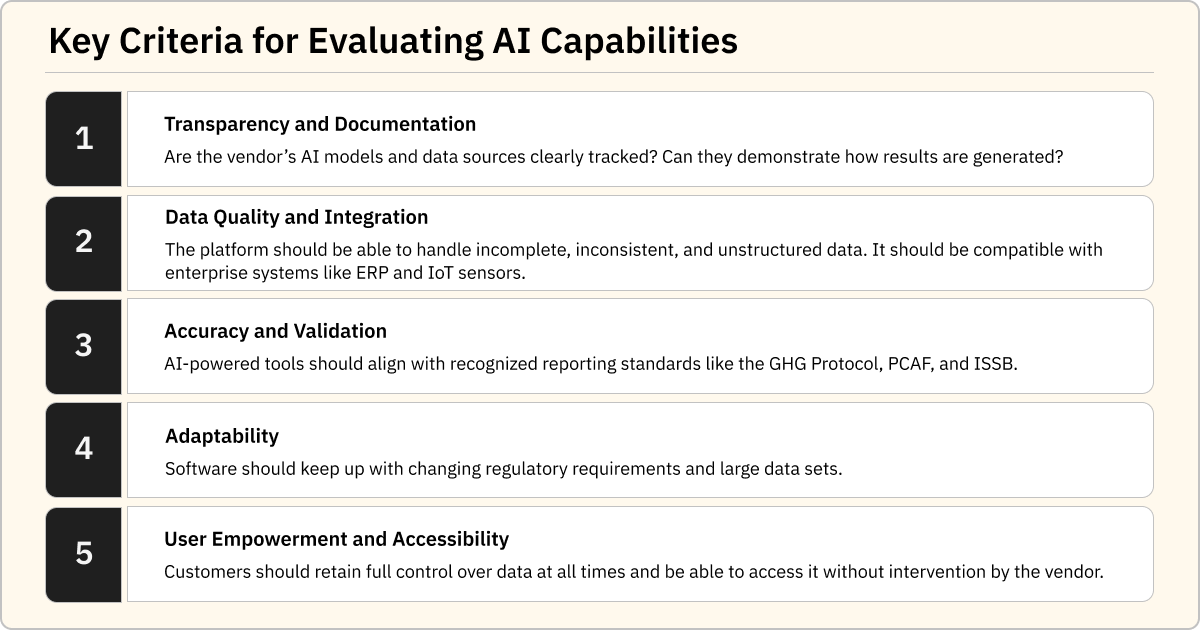
Key Criteria for Evaluating AI Capabilities
Before selecting a vendor, it’s essential to translate these capabilities into clear, practical evaluation criteria. Below are a few considerations that will help you assess whether a platform’s AI is truly mature, reliable, and designed to strengthen your carbon accounting process.
1. Transparency and Documentation
Are the vendor’s AI models and data sources clearly tracked? Can they demonstrate how results are generated?
2. Data Quality and Integration
The platform should be able to handle incomplete, inconsistent, and unstructured data. It should be compatible with enterprise systems such as ERP and IoT sensors.
3. Accuracy and Validation
AI-powered tools should align with recognized reporting standards like the GHG Protocol, PCAF, and ISSB.
4. Adaptability
Software should keep up with changing regulatory requirements and large data sets.
5. User Empowerment and Accessibility
Customers should retain full control over data at all times and be able to access it without intervention by the vendor.
Data Security and Ethical Use of AI in Carbon Accounting
Lack of adequate AI controls can create serious risk exposure.
As AI becomes more embedded in carbon accounting, the safeguards surrounding it matter as much as the capabilities themselves.
Carbon data often contains competitively sensitive information, such as pricing, supplier relationships, operational activity, making protection and governance essential. Without clear controls, AI systems can introduce security vulnerabilities, compliance risks, or unintended misuse.
Responsible vendors invest in both AI governance and information security frameworks that define how models are trained, monitored, and updated. These controls help ensure that customer data stays segregated, encrypted, and inaccessible to external AI systems unless explicitly permitted. They also minimize risks associated with model drift, incorrect outputs, or exposure of confidential information.
Organizations should seek platforms that balance innovation with rigorous oversight, ensuring that AI enhances carbon management without compromising security or compliance.
Guiding Principles for Secure and Ethical Use of AI in Carbon Accounting
1. Risk Identification and Mitigation
Vendors should use diverse testing methods to evaluate model behavior, security posture, and reliability before deployment.
2. Patterns of Misuse
Vendors should continuously monitor AI systems after deployment to identify and address vulnerabilities, incidents, emerging risks, and misuse, facilitating third-party and user reporting of issues.
3. Transparent Reporting
Strong vendors also maintain transparent reporting practices. They document model limitations, intended use cases, and system behavior so customers understand exactly what the AI can, and cannot, do.
4. AI Governance and Risk Management Policies.
Vendors should develop, implement, and disclose risk-based AI governance, privacy policies, and mitigation measures, ensuring accountability throughout the AI lifecycle.
5. Robust Security Controls.
Vendors should invest in comprehensive security controls, including physical, cybersecurity, and insider threat safeguards, securing model weights, algorithms, servers, and datasets.
6. Data Input Measures and Protections
Measures should be in place to manage data quality and protect personal data and intellectual property, supporting transparency of training datasets and compliance with legal frameworks.
AI Security Certifications and Standards to Look For
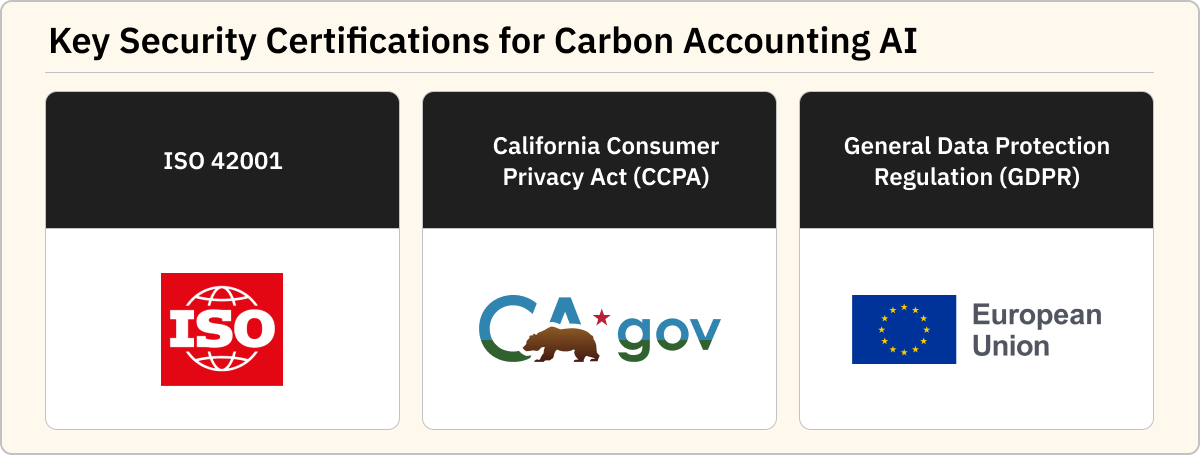
One way to ensure your carbon accounting vendor meets stringent criteria for security and controls is to check for third-party certifications. Key frameworks to look for include:
ISO 42001: Certification shows that an organization has implemented a structured, auditable AI Management System that meets international standards for responsible, transparent, and well-governed use of AI.
CCPA: The California Consumer Privacy Act gives individuals control over their personal data, which is important for carbon accounting software because it ensures that any employee or customer data used in emissions tracking is handled lawfully and transparently.
GDPR: The EU’s General Data Protection Regulation protects personal data and requires strict safeguards, making it essential for carbon accounting software to securely manage any identifiable information included in activity data or supporting documents.
Questions to Ask When Assessing Vendors
Choosing the right vendor requires looking beyond feature lists and digging into how their AI is built, governed, and supported. The suggested questions below offer a structured way to compare providers and ensure their technology meets your organization’s expectations for quality, transparency, and data protection.
How do you use AI or machine learning in carbon accounting?
The vendor should be able to describe in detail how its AI capabilities enhance the carbon accounting process. Look for specific features like hybrid cloud architecture, anomaly detection, a reliable AI assistant, natural language emission factor mapping, and utility bill parsing.
Can you explain your AI solution’s decisions and predictions?
Vendors should be able to explain how their AI arrives at decisions, including which data sources are referenced, how predictions are validated, and what audit trails exist for oversight. The vendor should regularly evaluate model precision and performance using benchmarks and user feedback.
Which data privacy and protection regulations do you comply with?
ISO 42001 certification is the gold standard. It shows that the AI solution meets international criteria for responsible, transparent, well-governed use of AI. The company’s use of AI should also comply with the California Consumer Privacy Act (CCPA) and the EU’s General Data Protection Regulation (GDPR).
Are there any measures in place to detect and prevent potential attacks or misuse of the AI tool?
Look for a combination of both human and automated guardrails to help detect potential attacks and misuse of AI tools. Customers should be able to easily report and provide feedback on the vendor’s AI tools to help detect potential issues early on.
Is there any input/output validation of data used by the AI?
The provider should utilize test-driven development and QA processes to validate AI inputs/outputs pre-release of any AI feature, as well as an automated safeguard system to monitor models and results after deployment.
Has the AI tool undergone any security audits or assessments?
The vendor should explain how it evaluates the security of its AI features, both before development and on an ongoing basis (annually, at a minimum). This includes reviewing security documentation, audits, certifications, and security roadmaps for all third-party technology (such as OpenAI).
Balancing Innovation With Responsibility
AI holds great promise for accelerating the shift to data-driven, automated carbon management and climate disclosure. Used correctly, it can do more than support compliance: It can boost strategic decision-making and operational efficiency. Companies should look for carbon accounting platforms that offer high-impact AI capabilities and meet stringent criteria for ethics, security, and data controls.
Learn how Persefoni uses AI to calculate emissions securely and efficiently.