

Greenhouse Gas Emissions and The Three Scopes
Updated:
January 13, 2026
·
[Read Time]
Module 1 introduces the fundamentals of greenhouse gases (GHG) and your business's role in the value chain. We’ll cover the importance of scope 3 emissions and the complexities associated with measuring them. By completing this module, you will:
The estimated time to complete is 20 minutes.
Before diving into the complexities of scope 3 emissions, it’s important to understand the fundamentals of GHG emissions.
A GHG is any gas that traps heat in the atmosphere. As more GHGs are emitted, they trap more heat in the atmosphere, intensifying climate change in what is known as the Greenhouse Gas Effect.
The GHG Protocol covers the accounting and reporting of the seven greenhouse gases covered by the UNFCCC and Kyoto Protocol. The table below provides information about the seven GHGs and their sources:
As businesses carry out routine operations, such as transporting goods or manufacturing materials, they release greenhouse gases into the atmosphere. On a global scale, this contributes to the Greenhouse Effect and intensifies climate change. The Greenhouse Gas Effect intensifies climate change by trapping heat in the Earth's atmosphere from added greenhouse gases.
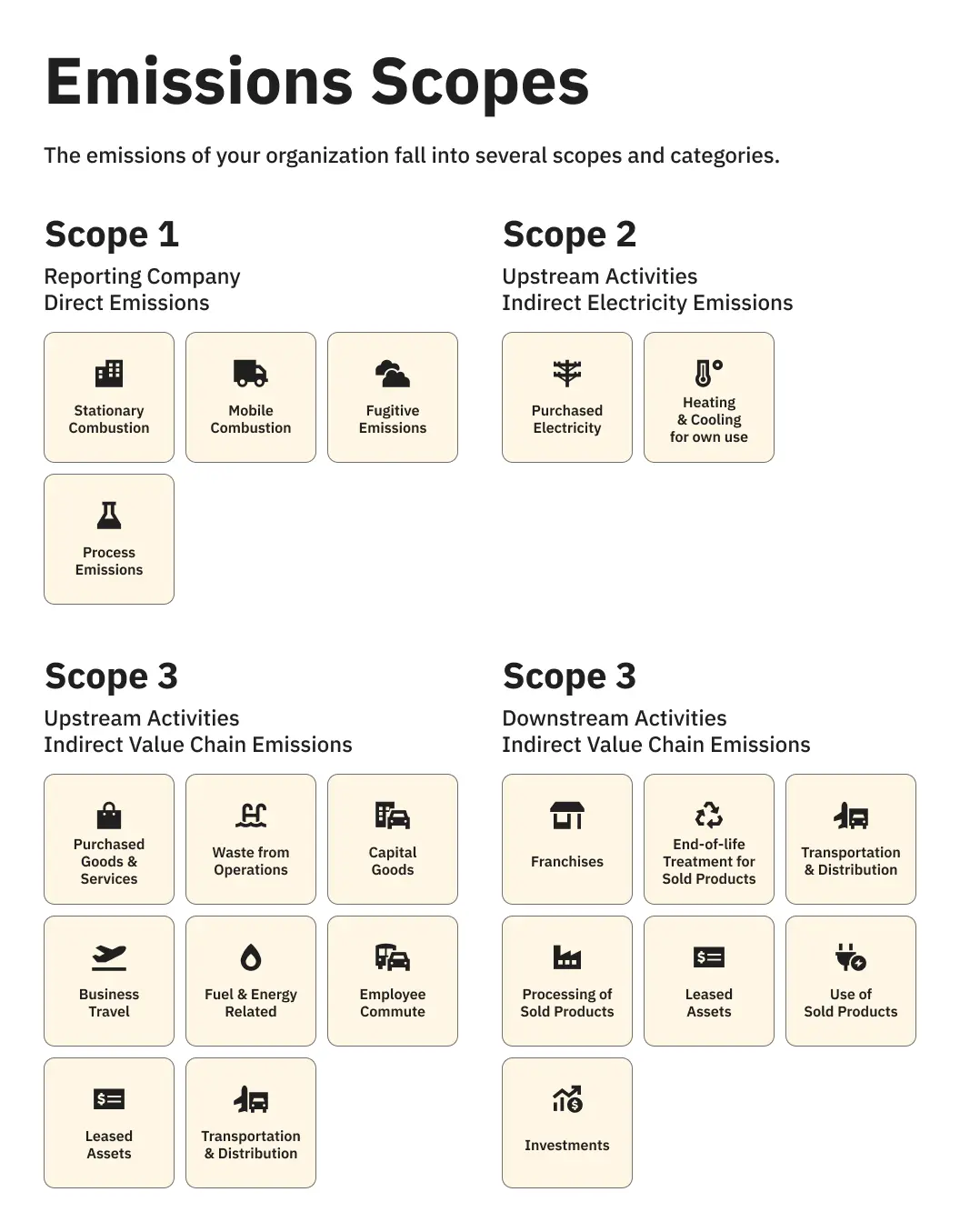
The GHG Protocol sets widely recognized standards for GHG accounting, also known as carbon accounting. These standards are employed by various entities, including organizations and governments, to manage, measure, and report their GHG emissions. The GHG Protocol classifies emissions into three distinct categories:
Scope 1 emissions are direct emissions from sources that are owned or controlled by the organization.
Examples include:
These emissions are typically the easiest to measure because the organization has direct control over the sources.
Scope 2 emissions are indirect emissions from the generation of purchased energy, such as electricity, steam, heating, or cooling that the organization consumes.
Although these emissions occur at a utility or energy provider’s facility, they are attributed to the reporting organization because they result from its energy use.
Scope 3 emissions include all other indirect emissions that occur throughout an organization’s value chain and are not included in Scope 2. These emissions arise from activities associated with the organization but occur outside its direct ownership or control.
The GHG Protocol’s Scope 3 Standard organizes these emissions into 15 categories, covering a wide range of upstream and downstream activities, including:
Scope 3 emissions are often the largest share of an organization’s total carbon footprint, but they are also the most challenging to measure. This complexity arises from factors such as:
Despite these challenges, organizations cannot fully understand or address their climate impact without accounting for Scope 3 emissions.
While many organizations focus first on reducing operational emissions (Scopes 1 and 2), doing so alone is often insufficient to meet long-term climate goals or stakeholder expectations. For most industries, the majority of emissions occur outside direct operations, embedded in supply chains, logistics, product use, and investments.
Scope 3 emissions provide critical insight into where climate risks and reduction opportunities truly exist across the value chain.
Throughout this course, we will use a fictional computer manufacturing company, Agora, to illustrate Scope 3 concepts and examples.
Agora designs, manufactures, and distributes computers that are sold through retail channels. Customers purchase these products, have them shipped or transported home, and use them over several years. While Agora’s direct operations include offices and limited manufacturing oversight, most emissions associated with its products occur outside its direct control—during component manufacturing, transportation, product use, and end-of-life disposal.
Stephanie, Agora’s sustainability manager, is facing increasing pressure from investors to measure Scope 3 emissions in anticipation of upcoming climate disclosure requirements. Even before collecting detailed data, Stephanie can reasonably infer—based on Agora’s industry and business model—that the company’s value-chain emissions represent the majority of its carbon footprint.
This insight sets the foundation for the Scope 3 measurement, data collection, and reduction strategies explored throughout the course.

