Emission factors (EFs) are the foundation of carbon accounting. Selecting emission factors from transparent, peer-reviewed datasets helps ensure scientific rigor and ultimately leads to more reliable, auditable climate disclosure. To prepare for stakeholder scrutiny and regulatory compliance, companies should retain full visibility and control over the emission factors behind their GHG inventory.
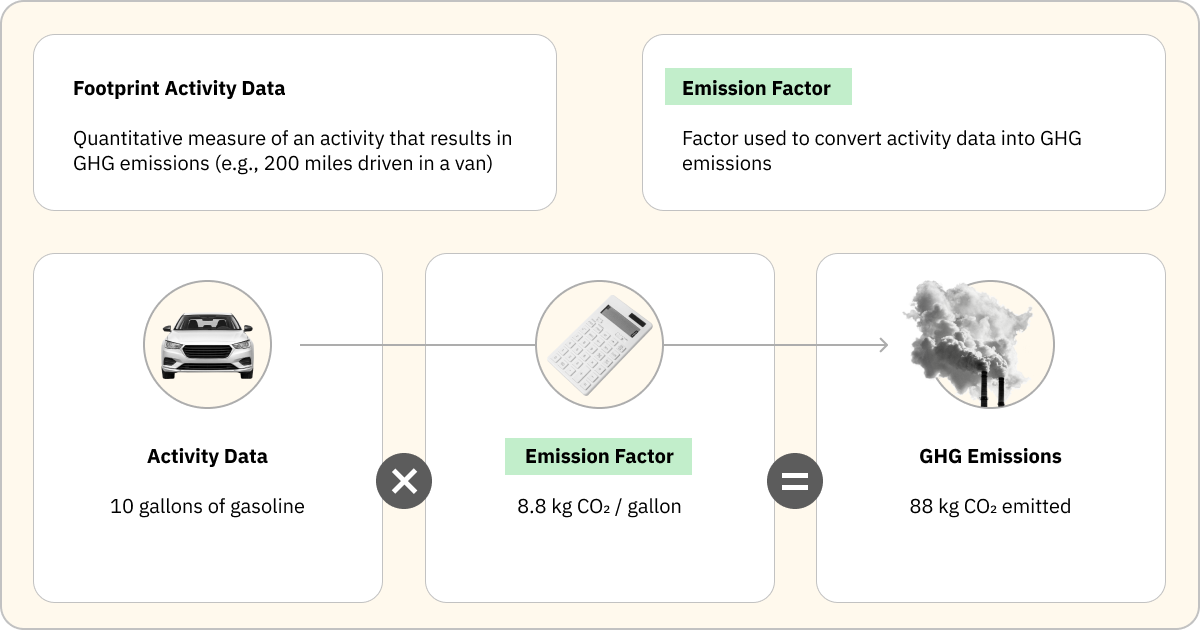
At the core of nearly every greenhouse gas inventory is a simple equation: activity data multiplied by an emissions factor. Yet selecting the right emissions factor is one of the most complex and judgment-driven steps in carbon accounting. Differences in data quality, geography, and methodology can significantly influence your reported carbon footprint, which makes emission factor selection a pivotal decision.
In this article, we’ll do a deep dive into emission factors: what they are, why they matter, and how to select the right emission factor sets for your GHG inventory.
What are emission factors?
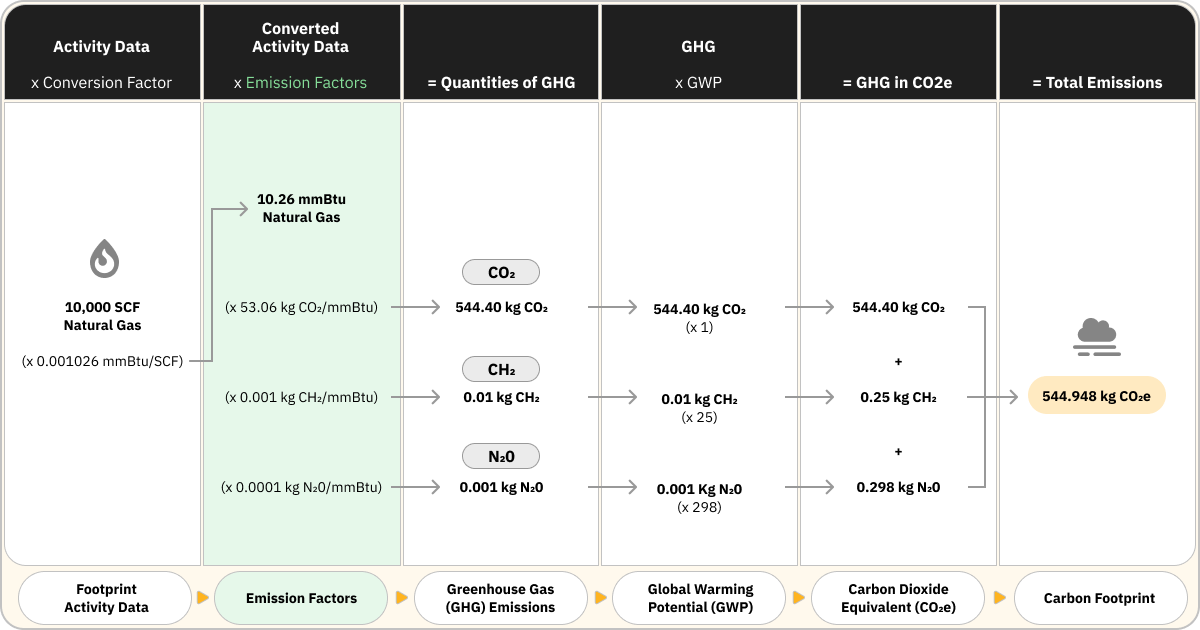
Emission factors represent the greenhouse gases associated with a given activity.
Emission factors (EFs) are the backbone of carbon accounting. In simple terms, an emission factor is a representative value that is used to quantify the greenhouse gases associated with a specific unit of activity. To ensure accurate, consistent, and credible carbon inventories, it’s essential to use appropriate emission factors.
Emission factors are expressed as emissions per unit of activity—such as kilograms of CO₂e (carbon dioxide equivalent) per kilowatt-hour of electricity, or per liter of fuel. They are often based on a sample of measurement data, averaged to establish a representative rate of GHG output for a specific activity under a specific set of operating conditions.
How are emission factors developed?
Scientists use a variety of methods to identify emission factors for different activities and products.
Determining emission factors can be complex: Every activity, product, or process produces a different mix of greenhouse gases (e.g., CO2, CH4, N₂0, HFCs, PFCs, SF6, and NF3). These gases differ in their atmospheric lifetimes and how effectively they trap heat in the atmosphere. Emission factors need to reflect the relative contribution of each greenhouse gas and its impacts.
Emission factors can also vary depending on the characteristics of the activity itself. Key drivers include fuel type, technology, operating conditions, and geography.
Scientists have different methods for determining emission factors. Sometimes they can use well-established chemical relationships. For example, stoichiometry (the math behind chemical reactions) is used to estimate the emissions from fuel combustion based on the fuel’s composition. In many cases, they use direct measurements of real processes, such as testing emissions from engines and industrial equipment, to pinpoint a representative value. When direct measurement data is limited, experts may combine multiple sources of available data and apply their judgment to develop representative values.
The direct measurement of greenhouse gas emissions from a specific source is rare due to cost, scale, and practical constraints. Emission factors fill this gap by providing standardized, representative values. These values must be updated regularly, since they can change as a result of technological developments, updated science, environmental conditions, and other influences.
Emissions Calculation Example
Common emission factor sources
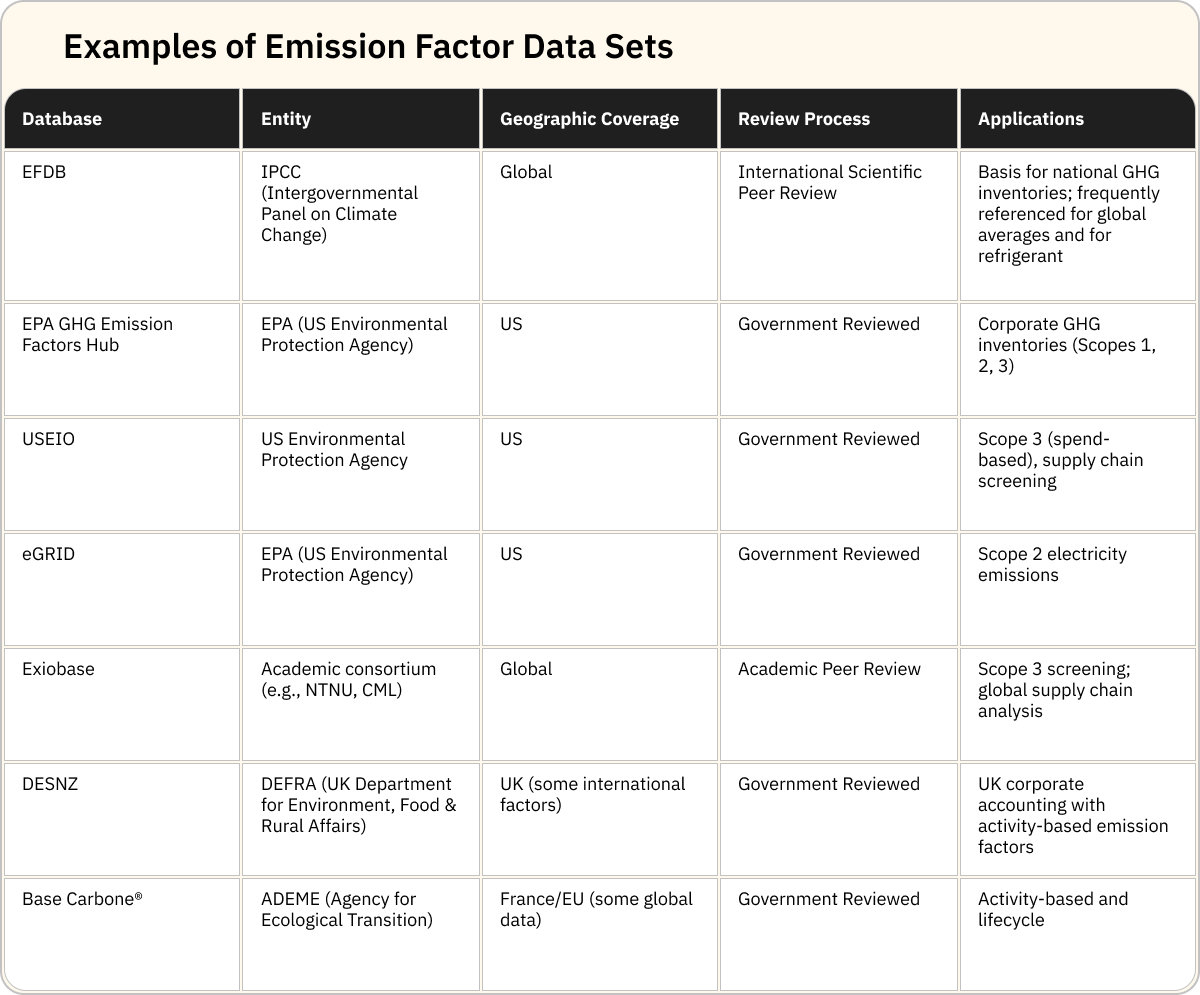
Databases vary in applications and methodology.
A variety of organizations have compiled emission factor databases, each with different applications and methodologies. Examples include IPCC Emission Factor Database, the US Environmental Protection Agency (EPA) Emission Factor Hub, the UK’s DEFRA database, and Exiobase, among others. For the most reliable carbon accounting, companies should prioritize scientifically peer-reviewed datasets from reputable sources.
Why the right emission factors matter
EFs can affect accuracy, credibility, and decision-making.
Using appropriate emission factors is crucial for credible and decision-useful GHG accounting. It ensures that your reported emissions reflect real-world conditions, supporting effective and efficient climate action. Selecting incorrect factors can lead to significant errors and misreporting, which creates potential compliance risk and impedes strategic planning.
Impacts of emission factor selection
Accuracy. Emission factor selection is one of the primary drivers of inventory accuracy. Using factors that do not reflect the actual activity can introduce material error—for example, applying a national-average electricity factor to a facility on a distinct regional grid, or using generic combustion factors when fuel composition is known. These inaccuracies compound when aggregated across sites, categories, or time periods.
Completeness. The choice of emission factors also affects whether emissions are fully captured. For example, using combustion-only factors where lifecycle factors are required can omit upstream impacts. Certain reporting streams require the inclusion of well-to-tank emissions, meaning these estimates would be considered incomplete. Incorrect factor selection leads to systematic underestimation and gaps in the inventory.
Consistency. Consistent emission factors across reporting periods and organizational boundaries enable meaningful trend analysis. Without this alignment, differences in reported emissions may reflect factor choices rather than actual performance.
Comparability. Standardized application of emission factors is what makes GHG data comparable across organizations, reporting periods, and geographies. When factor selection is inconsistent or undocumented, year-over-year trend analysis becomes unreliable, which erodes the usefulness of the inventory for tracking decarbonization progress.
Transparency. Under mandatory reporting frameworks, GHG inventories are subject to third-party verification. Emission factor selection must be clearly documented, including source, selection, and year. This allows internal stakeholders, auditors, and reviewers to understand and assess the validity of the inventory.
Relevance. A GHG inventory's value to the organization extends beyond compliance. Emission hotspot identification, supplier engagement prioritization, and internal abatement modeling all depend on the reliability of the underlying factors. Inventories built on poorly matched emission factors produce a distorted picture of where reductions are achievable, and at what cost.
Different emission estimation approaches
Apply the highest feasible tier of EFs to your most material sources.
The IPCC's Guidelines for National Greenhouse Gas Inventories introduce a tiered framework for categorizing how emissions are estimated, with each tier representing a higher level of methodological sophistication (and therefore accuracy). While the framework was designed for national inventory reporting, it also provides a useful reference for evaluating the quality of emission factor choices in corporate accounting.
The tiers correspond to calculation accuracy. Achieving accuracy requires more robust underlying data and more complex methodologies. In practice, the right tier depends on what activity data you can reliably collect and whether the emission reduction potential of a source category justifies the additional effort.
IPCC Emission Estimation Tiers
Tier 1 applies IPCC default emission factors against national or global activity data. It is the entry-level approach, appropriate when source-specific or country-specific data is unavailable, but it carries the highest uncertainty of the three tiers.
Tier 2 introduces country-specific emission factors derived from national measurement programs, paired with more disaggregated activity data. It reflects local conditions more accurately than Tier 1 and is the standard expectation for significant emission sources in well-resourced inventories.
Tier 3 encompasses higher-order methods, including process-specific models, facility-level measurement data, and, in some cases, continuous emissions monitoring. It carries the lowest uncertainty and is typically reserved for major emission sources where Tier 2 accuracy is insufficient for reporting or verification purposes.
For corporate inventories, the practical implication is straightforward: Apply the highest feasible tier to your most material emission sources. Tier 1 global averages are acceptable for minor spend-based value-chain categories; they are not defensible for your primary combustion sources or energy consumption footprint in markets where more accurate factors are available.
.png)
Key Questions in Selecting Emission Factors
1. What footprint source am I calculating?
Your first step is to clearly define which emission source (and scope) you’re calculating, because that determines which emission factors and databases are appropriate.
2. Can I use supplier or activity-specific data?
Values that directly reflect the unique context of your activity are always going to lead to the most accurate representation of your emissions.
3. What are the primary drivers of emissions for this footprint source?
Different sources are influenced by different factors. For example, electricity will be influenced by geographic location. Stationary combustion will be influenced by fuel type, and mobile combustion will be influenced by vehicle type, fuel, and distance.
4. Does the emission factor align with temporal and accounting boundaries?
Ensure the emission factor matches both the year of your activity data and the required accounting approach, including whether emissions are reported as direct (e.g., combustion-only) or include upstream lifecycle impacts, and whether electricity is calculated using location-based or market-based methods.
5. Is this source credible and methodologically sound?
Emission factors from databases that are transparent, regularly updated, and scientifically peer-reviewed will be more reliable.
.png)
Activity data and spend-based data
When combined with activity data, emission factors can create a relatively clear picture of your GHG impact. Activity data provides quantitative information on operational processes—like the amount of electricity consumed in an office building each year. If a building consumes 100 MWh of coal-based electricity with an emission factor of 1,000 CO2e/kWh, the calculation might look something like this:
100MWh (activity data) x 1,000 CO2e (emission factor) = 100,000 CO2e.
When more direct or physical data is not available, spend-based data can be used to approximate physical activity. With the spend method, emission factors represent an estimate of emissions per dollar spent. This method is less accurate than physical activity data because the costs of goods and services fluctuate, and emission factors lack scenario-specific context. However, collecting activity data can be challenging, especially across a company’s value chain (scope 3), so spend-based data remains a common way to measure emissions.
Best practices for selecting emission factors
Emission factor selection is not a one-time decision. It requires ongoing attention as your business changes, reporting frameworks evolve, and underlying datasets are updated. For rigorous, reliable GHG reporting, you can follow the best practices below.
1. Get clear on scope
Before determining the methodology, data source, and type of emission factor to use, you need to be clear on the scope of your emissions. Scopes 1, 2, and 3 require fundamentally different types of emission factors (e.g., combustion, electricity grid, or lifecycle), and choosing the wrong scope can lead to misreporting.
2. Use transparent, peer-reviewed EF datasets
Whenever possible, you should rely on emission factor sets from transparent, peer-reviewed sources like the IPCC. This helps ensure that scientific rigor was used to determine the emission factors (and will ultimately lead to more reliable calculations).
3. Make sure emission factors are up-to-date
Emission factors change over time. It’s important to understand the temporal influence to avoid using outdated datasets. Footprint sources like fuel combustion and refrigerants are relatively stable over time because emissions are driven by the physical and chemical properties of the materials. In these cases, using the most recent emission factor set is appropriate to reflect improved scientific understanding and measurement techniques. The carbon content of natural gas or the global warming potential of a refrigerant does not depend on the year of use.
For other footprint sources, emissions are strongly influenced by time-dependent external conditions. Purchased electricity emission factors change significantly due to shifts in the energy mix, and spend-based emission factors vary as economic conditions evolve. In these cases, emission factors should be aligned with the year of your activity data to reflect the real-world conditions from that point in time.
4. Align boundaries
Mismatched boundaries are a common error in carbon accounting and can lead to significantly under- and over-reported emissions. Emission factors should align with what you’re counting (like location-based electricity vs. market-based electricity, or combustion-only vs. lifecycle). Calculating the well-to-tank emissions of diesel (crude oil extraction, transportation, refining, and distribution), for example, will lead to significantly higher estimates than calculating tailpipe emissions alone.
5. Match geography
Emission factors often vary widely based on location. Most notably, electricity emission factors reflect the grid generation mix of that region, which determines the emissions intensity of electricity usage. For example, the electricity your company consumes in Washington state may come from low-carbon hydroelectric power, while electricity in Texas will likely be derived from burning fossil fuels, which is far more GHG-intensive. It’s essential to match geography as precisely as possible.
6. Maintain visibility and control
You should be able to easily trace back the emission factors used in your carbon accounting and understand the methodology and choices behind them. Relying on opaque “black box” emission factors can undermine confidence in your carbon accounting, hinder auditing, and inhibit strategic planning.
.png)
Why emission factor transparency matters in practice
Visibility into emission factors is essential for reliable, decision-useful carbon accounting.
Carbon accounting software and services should offer you full visibility into which emission factors are used, along with ownership and control in selecting them.
Opaque, “black box” emission factors and methodologies won’t allow you to easily verify the ‘math’ behind your carbon inventory, which can lead to issues further down the road. For example, if your business operates in California but your purchased electricity is calculated with an emission factor for the American Southwest, you’ll likely be artificially inflating emissions. Visibility into your emissions would allow you to flag the mismatch and avoid overreporting.
The bottom line: If you can’t trace and understand the calculations behind your reported emissions, you open the door to misstatements—and potential reputational and compliance risk. This is especially important as climate disclosure regulations like Europe’s CSRD and California’s SB 253 kick in and companies prepare for third-party auditing.
.png)
Building a reliable carbon inventory
Emission factors can make or break your carbon accounting process. Using transparent, peer-reviewed datasets and retaining full visibility into emission factors will help ensure that your GHG calculations are reliable, comparable, and decision-useful—ultimately protecting your company’s credibility and competitiveness.